The laboratory houses analytical systems for magnetic sector and quadrupole mass spectrometry, with a variety of sample heating and gas introduction systems.
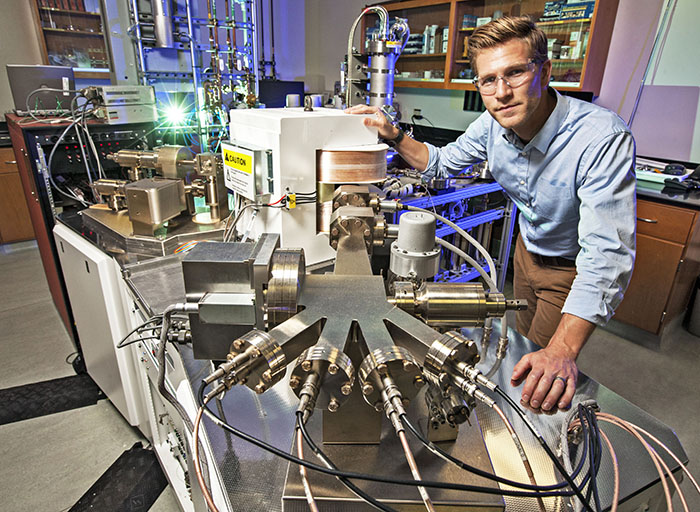
Mass Spectrometry
- The laboratory houses two Nu Instruments Noblesse mass spectrometers.
- The first instrument (NG1), installed in 2013, is equipped with six Faraday cup detectors and four ion-counting, discrete dynode multiplier detectors.
- The second instrument (NG2), installed in 2018, is equipped with five Faraday cup detectors and five ion-counting, discrete dynode multiplier detectors.
- Quadrupole mass spectrometry is performed using a Pfeiffer Prisma Plus QME 220.
Sample Heating
Noble gases are extracted from solid samples using a variety heating techniques.
- Precise, temperature-controlled heating experiments are performed using a Photon Machines Thermochron Fusions diode laser (either 75W or 150W; λ = 970 nm) equipped with a co-axially aligned optical pyrometer. This system is designed for the simultaneous acquisition of diffusion kinetics and isotopic data.
- Direct fusion of samples is performed using a Photon Machines Fusions CO2 laser (55W). The Fusions CO2 is designed for the direct heating and melting of samples, including optically transparent phases.
- In situ noble gas isotope measurements are performed using a Photon Machines Analyte G2 ultra-short pulse 193 nm Excimer laser ablation system. The Analyte G2 provides micron-scale, spatially resolved noble gas isotope ratios.
Gaseous Introduction Systems
Automated pipette systems, variably equipped with getters and LN2 cryogenic traps, are available for controlled introduction of gaseous samples. Most of these pipettes are dedicated to gas standards, including atmospheric noble gases used for determining spectrometer mass discrimination and mono-isotopic compositions (e.g., 3He and 124Xe) used for high-precision abundance determinations.
Gas Processing
The gas processing line for NG1 is equipped with two Janis cryogenic separators (one bare metal and one charcoal trap), a cryogenic water trap, and two SAES getters (one hot and one cold) for noble gas purification.
The gas processing line for NG2 is equipped with one Janis cryogenic separators (bare metal), a cryogenic water trap, and two SAES getters (one hot and one cold) for noble gas purification.